"상황이 통제 불능"- 모든 것이 부족하고 가격이 치솟고 있다 : 다음에 일어날 일
"Things Are Out Of Control" - There Is A Shortage Of Everything And Prices Are Soaring: What Happens Next
BY TYLER DURDEN
FRIDAY, MAR 19, 2021 - 11:45 AM
수요일 기자 회견에서 파월 Jay Powell 의장은 연준이 역사적인 실험을 시작하고 있음을 확인했습니다. 과열된 경제에서 무기한 기간 동안 불타오르는 인플레이션을 환영하고 모든 것이 "일시적"이라는 기본 가정 하에 인플레이션은 몇 년 안에 정상으로 돌아올 것이며, 연준의 금리가 여전히 0이 될 2023 년 이전에 확실히 회복될 것이라고 말합니다.
이러한 가정에는 큰 문제가 있습니다. FOMC 회원들 대부분이 독립적으로 부유하고 "비 핵심" CPI 소비자물가지수 바구니 품목 가운데 매일의 구매에 대해 연준이 제공한 카드의 비용을 청구할 수있는 그 회원들에 비해 대다수의 미국인들은 문제에 봉착합니다. 다만 특수계층 회원들은 다른 사람이 구매 비용을 지불하도록하거나 현재 폭주 인플레이션 기간을 넘어서는 사치를 누릴 수 있습니다. 이는 특히 중간 상품 생산자가 가격을 더 높이고 인플레이션을 통과하기 시작하면 미국 소비자의 구매력은 확실히 압도당할 것입니다.
많은 독자들이 기억하지 못할 수도 있지만, 악명 높은 볼커 연준 Volcker Fed과 두 자릿수 금리 인상으로 이어진 "일시적인" 인플레이션 사례 중 하나는 아랍 석유 금수조치에서 발생한 유가였습니다. 그리고 그것은 10 년 넘도록 회복되지 못했습니다.
In Wednesday's press conference, Jay Powell confirmed that the Fed is setting off on a historic experiment: welcoming a conflagration of red-hot inflation for an indefinite period of time in an overheating economy, with the underlying assumption that it's all "transitory" and that inflation will return to normal in a few years, and certainly before 2023 when the Fed's rates will still be at zero.
There is a big problem with that assumption: while FOMC members, most of whom are independently wealthy and can just charge their Fed card for any day to day purchases of "non-core" CPI basket items, the vast majority of the population does not have the luxury of having someone else pay for their purchases or looking beyond the current period of runaway inflation, which will certainly crush the purchasing power of the American consumer, especially once producers of intermediate goods start hiking prices even more and passing through inflation.
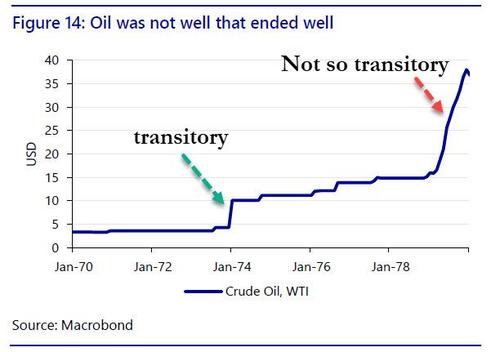
Many readers may not recall, but one such instance of "transitory" inflation that proved to be anything but and led to the infamous Volcker Fed and its double digit rate hikes, was the price of oil which took off in the Arab oil embargo and then refused to come back for over a decade.
비엠더블유 대표이사 BMW CEO는 다음 주, 몇 달 동안 칩 부족상황을 배제할 수 없다
BMW CEO cannot exclude chip outages in next weeks, months
www.msn.com/en-gb/news/other/bmw-ceo-cannot-exclude-chip-outages-in-next-weeks-months/vi-BB1eGmVH
그림14 : 석유는 잘되지않았고 잘 끝났다
1974년 1월: 배럴당 4달러에서 10달러로 상승 [일시적 상태 transitory]
1978년 1월: 배럴당 15달러에서 35달러로 상승 [일시적 상태아님 Not so transitory]
그러나 파월의 연준 Powell Fed는 수요 요소가 있는 것으로 간주되는 폭주 인플레이션의 이전 에피소드에 대한 모든 유사점을 무시하고 그 결과 전례없는 공급망 중단 (즉, 공급 붕괴)이 발생하고 있다고 판단합니다. 중국과의 무역 전쟁과 최근에는 전통적인 공급망 중개자 사이에 혼란을 불러 일으키는 전염병의 원인이 되었습니다.
확실히 연준은 사실상 모든 공급망에 혼란이 있었다는 사실이 옳습니다. 가장 최근의 제조 ISM에 대한 응답자들이 진정으로 얼마나 나쁜지 이해하기 위해 말한 내용만 읽으면 됩니다 :
The Powell Fed, however, is eager to brush aside any analogues to previous episodes of runaway inflation which it sees as having a demand component, and merely ascribes what is taking place to unprecedented supply chain disruptions - i.e., collapse in supply - as a result of both the trade war with China and, more recently, the covid pandemic, which have unleashed chaos among traditional supply-chain intermediaries.
To be sure, the Fed is certainly right that there has been turmoil within virtually all supply chains: one needs to only read what the respondents to the most recent mfg ISM said to get a sense of how bad it truly is:
- “이제 모든 것이 통제 불능입니다. 모든 것이 엉망이고 우리는 광범위한 부족 사태를 보고 있습니다.” (전기 장비, 가전 제품 및 부품)
- “공급망이 고갈되었습니다. 공급망의 상하 재고가 비어 있습니다. 조달기간이 증가하고 가격이 상승하며 수요가 증가합니다. 걸프만 연안의 급속 동결로 부족 기간이 연장될 것으로 예상됩니다.” (화학 제품)
- “코로나 바이러스 [COVID-19] 전염병은 현지 및 해외 3, 4 차 공급 업체로부터 자재를 확보하는 데 영향을 미치고 있습니다. 공급 업체는 제조에 사용할 수있는 리소스 [인력이 부족함]에 대해 불평하고 있어 주요 배송 문제가 발생합니다. " (컴퓨터 및 전자 제품)
- “지난 2 개월 동안 신규 주문 기록이 40 % 증가했습니다. 주문이 너무 많아 일정에 맞춰 제품을 출고할 인력이 없습니다.” (1 차 금속)
- “새로운 주문에 대해 긴박감을 느끼고 있습니다. 고객들은 안정성이 다가오고 주문 흐름이 증가하고 있다는 인상을 주고 있습니다. " (섬유 공장)
- “가격이 너무 빨리 상승하여 많은 사람들이 [상황]이 지속 가능한지 궁금해 하고 있습니다. 부족으로 인해 업계는 적어도 2 분기까지 공급을 우려하고 있습니다.” (목제품)
- “지난 달에 재료 공급업체의 연체 배송률이 더 높았습니다. 우리는 여전히 생산 라인을 완전히 인력으로 유지하는 데 어려움을 겪고 있습니다. 식당이 다시 문을 열면서 식품 서비스 부문에서 빠르고 대량 주문이 급증할 것으로 예상합니다.” (식음료 및 담배 제품)
- “최근 몇 달 동안 철강 가격이 크게 상승하여 공급 업체와 우리가 입찰하는 새로운 작업 제안에 대한 비용이 증가했습니다. 또한 국제 제철소 / 공급 업체가 부과하는 관세 및 반덤핑 수수료 / 벌금이 우리에게 전달되고 있습니다.” (운송 장비)
- “Things are now out of control. Everything is a mess, and we are seeing wide-scale shortages.” (Electrical Equipment, Appliances & Components)
- “Supply chains are depleted; inventories up and down the supply chain are empty. Lead times increasing, prices increasing, [and] demand increasing. Deep freeze in the Gulf Coast expected to extend duration of shortages.” (Chemical Products)
- “The coronavirus [COVID-19] pandemic is affecting us in terms of getting material to build from local and our overseas third- and fourth-tier suppliers. Suppliers are complaining of [a lack of] available resources [people] for manufacturing, creating major delivery issues.” (Computer & Electronic Products)
- “We have seen our new-order log increase by 40 percent over the last two months. We are overloaded with orders and do not have the personnel to get product out the door on schedule.” (Primary Metals)
- “A sense of urgency is being felt regarding new orders. Customers are giving an impression that a presence of stability is forthcoming and order flow is increasing.” (Textile Mills)
- “Prices are rising so rapidly that many are wondering if [the situation] is sustainable. Shortages have the industry concerned for supply going forward, at least deep into the second quarter.” (Wood Products)
- “We have experienced a higher rate of delinquent shipments from our ingredient suppliers in the last month. We are still struggling keeping our production lines fully manned. We anticipate a fast and large order surge in the food-service sector as restaurants open back up.” (Food, Beverage & Tobacco Products)
- “Steel prices have increased significantly in recent months, driving costs up from our suppliers and on proposals for new work that we are bidding. In addition, the tariffs and anti-dumping fees/penalties incurred by international mills/suppliers are being passed on to us.” (Transportation Equipment)
뱅크오브아메리카 BofA의 최고 투자책임자인 마이클 하트넷 Michael Hartnett조차도 그의 최근 흐름도표 Flow Show 노트 중 하나에서 다음과 같은 "주요 거리에서 들었던" 일화를 던졌습니다.
“우리의 전세계 공급망과 제품 및 서비스를 제공할 수있는 능력은 노동력 및 원자재 부족으로 인한 가격 상승, 원자재 가격 상승, 제조 지연 및 운송 중단으로 인해 상당한 영향을 받고 있습니다. 직접적으로 말하면 우리의 비용은 증가하고 있으며 과거보다 훨씬 더 변동적입니다.” -3 월 3 일 CA 부동산 개발자에게 가격 인상 알림.
Even BofA's Chief Investment Officer, Michael Hartnett, threw in the following "heard on main street" anecdote in one of his recent Flow Show notes:
“Our worldwide supply chain, and ability to provide products and services to you, is being significantly impacted by increased prices resulting from labor and raw material shortages, escalating raw material prices, manufacturing delays and transit interruptions. Stated directly, our costs are increasing and are much more volatile than in the past.” - Mar 3rd price increase notification to CA real estate developer.
문제가 너무 심각해지면서 여러 지역 연준 Fed 비즈니스 설문 조사에서 지난 몇 달 동안 공급망 중단에 대해 구체적인 질문을 했습니다. 아래 차트에서 볼 수 있듯이 대부분의 제조 회사는 공급망 중단이 현재 생산에 부정적인 영향을 미치고 있다고 보고합니다. 또한 애틀란타 연준 Atlanta Fed의 설문 조사에 참여한 기업의 38 %는 공급 업체 지연이 보통에서 심각하다고 보고했으며 달라스 연준 Dallas Fed 응답자의 49 %는 중단으로 인해 투입물 가격이 의미있게 상승했다고 보고했습니다. 뉴욕 연준 NY Fed의 엠파이어 제조 조사 Empire Manufacturing Survey에서 응답자의 59 %는 공급망 중단으로 인해 새로운 공급 업체를 찾았다고 답했으며 58 %는 추가 재고를 구축하기 시작했다고 보고했습니다. 전반적으로 이러한 조치는 공급망 중단이 비즈니스 운영에 극적으로 부정적인 영향을 미치고 훨씬 더 높은 가격으로 이어지고 있음을 시사합니다.
The problem has become so acute that several of the regional Fed business surveys asked specific questions about supply chain disruptions in the last few months. As the chart below shows, a majority of manufacturing firms report that supply chain disruptions are currently negatively affecting production. Additionally, 38% of businesses in the Atlanta Fed’s survey reported that supplier delays were moderate to severe, while 49% of Dallas Fed respondents reported that disruptions had meaningfully raised input prices. In the NY Fed’s Empire Manufacturing Survey, 59% of respondents reported finding new suppliers due to supply chain disruptions, while 58% reported that they had started building extra inventories. Overall, these measures suggest that supply chain disruptions are dramatically and adversely impacting business operations, and leading to far higher prices.
캔사스시티 연준등 4개 지역의 제조회사 지분이 축소되는데 공급체인 방해로 인하여 달라스 연준은 61%가 됨

그것이 충분하지 않은 경우 공급망 중단의 원인을 더 잘 이해하기 위해 골드만삭 Goldman Sachs의 최근 보고서에서 은행은 중단에 대한 최근 언론 보도를 요약합니다.
If that wasn't enough, to better understand the cause of supply chain disruptions, in a recent report from Goldman Sachs the bank summarizes recent media reports on disruptions.
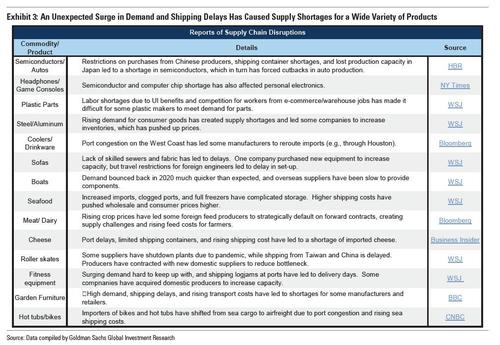
이 보고서의 놀라운 특징 중 하나는 공급망 중단이 "매우 널리 퍼져 있으며" 반도체 부족과 자동차 생산에 대한 끌림이 상당한 관심을 받고 있지만 골드만 Goldman 경제학자 잔 하치우스 Jan Hatzius는 헤드폰에서 소파, 롤러 스케이트에 이르기까지 다른 많은 소비재에 대해 언급합니다 - 올해도 공급 문제에 직면했습니다.
골드만 Goldman은 더 깊이 파고 들어 공급 부족이 다양한 제품에 영향을 미쳤지만 대부분의 경우 근본 원인은 동일하다고 지적합니다.
- 첫째, 제조업체는 예상보다 빠른 수요 회복으로 인해 경계를 늦추고 생산 요구 사항을 충족하기 위해 충분한 투입물을 미리 주문하지 않았습니다.
- 둘째, 바이러스로 인해 운송 서비스가 제한되는 동안 물품 수요가 증가함에 따라 선적 컨테이너 공급 부족과 서해안 항구의 혼잡 문제가 발생하여 선적이 오래 지연되었습니다.
One striking feature of these reports is that supply chain disruptions are "very widespread" and although the semiconductor shortage and its drag on auto production has garnered significant attention, Goldman economist Jan Hatzius notes that many other consumer goods - from headphones to sofas to roller skates - have also faced supply challenges this year.
Digging deeper, Goldman then notes that although supply shortages have affected a wide variety of products, in most cases the root causes are the same:
- First, manufacturers were caught off guard by a faster-than-anticipated recovery in demand and hadn’t ordered enough inputs in advance to meet production needs.
- Second, the increase in goods demand while transportation services are limited by the virus has led to an undersupply of shipping containers and congestion problems at West Coast ports, resulting in lengthy shipping delays.
그러니 먼저 나쁜 소식 : 현재의 인플레이션 폭발이 진정으로 "일시적"이라고 하더라도- 연준이 공약하듯이 2021 년 하반기에 인플레이션이 반전될 것이라는 약간의 신뢰도를 내세우고 있습니다. 골드만 Goldman은 "위의 두 가지 중 어느 것도 가계 소득에 대한 재정적 지원이 상품 수요를 계속 증가시키고 바이러스가 미국과 무역 파트너의 광범위한 접종이 상품 수요와 공급을 모두 정상화 할 때까지 국제 상품 운송 서비스의 공급을 계속 방해할 것이기 때문입니다.
So first the bad news: even if the current burst of inflation is truly "transitory" - as the Fed vows, staking what little credibility it has that inflation will reverse in the second half of 2021 - Goldman concedes that "neither of the above two problems should abate soon" since fiscal support for household income should keep goods demand elevated and the virus should continue to disrupt the supply of international goods transport services until widespread inoculation in the US and its trade partners normalizes both goods demand and supply.
그러나 핵심 사항이 있습니다. 좋은 소식은 공급 문제가 주로 생산 제약이 아닌 운송에 의해 발생하기 때문입니다. 지난 봄에 공급업체가 중간제품 공급을 중단한 공장 폐쇄로 인해 급증한 지난 봄과 달리 골드만 Goldman, 그리고 연준 Fed는 공급 제약이 가격에 상승 압력을 가할 것이지만 실제 경제 활동에는 영향을 덜 미칠 것으로 예상합니다. 일부 수입 업체와 제조업체가 더 높은 비용으로 병목 현상을 완화한 방법의 예로서 일부 회사는 해상 운송이 아닌 항공으로 자전거 부품과 온수 욕조를 수입하기 시작했으며 다른 생산 업체는 대체 항구를 통해 수입품 경로를 변경하기 시작했습니다.
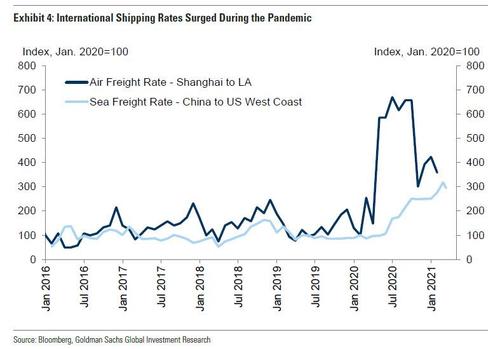
즉, 이러한 병목 현상은 긴장된 무역로에서 운송 비용을 크게 증가시키기 때문에 또 다른 비뚤어진 가격 인상으로 이어질 수 있습니다. 다음 차트에서 볼 수 있듯이 중국에서 미국으로의 배송비는 작년에 비해 약 3 배 증가했습니다. 제조업체가 이러한 비용을 소비자에게 전달함에 따라 이는 소비자 가격에 상승 압력을 가할 가능성이 있습니다.
But there is a silver lining: The good news is that because supply challenges are largely driven by transportation and not production constraints—unlike last spring when supplier delays spiked due to factory shutdowns that halted the supply of intermediate goods—Goldman, and by extension the Fed, expects that supply constraints will put upward pressure on prices but have less of an impact on real economic activity. As examples of how some importers and manufacturers have alleviated bottlenecks at higher costs, some companies have started importing bike parts and hot tubs by air rather than sea freight, and other producers have started rerouting imports through alternate ports.
That said, these bottlenecks can lead to another perverse price increase as they substantially increase transport costs in strained trade routes. As shown in the next chart, shipping costs from China to the US have roughly tripled over the last year. This will likely put upward pressure on consumer prices as manufacturers pass these costs on to consumers.
국제 선박수송율이 코로나 대창궐 동안 치솟았다 (2020년 7월항공운송율이 2020년1월에 비해 650%로 상승)
그러나 Goldman에 따르면 소비자 가격에 미치는 영향은 두 가지 이유로 특정 배송비의 엄청난 증가에 비해 약해질 가능성이 있습니다.
- 첫째, 동아시아 이외 지역의 배송비는 훨씬 더 적게 증가했습니다. 예를 들어, 생산자 물가 지수에 따른 국내 운송 비용 (제조품 총 운송 비용의 약 3/4을 차지함)은 바이러스 이전 수준에 비해 1.6 % 상승했습니다.
- 둘째, 총 배송비는 상품의 최종 가격에서 작은 부분에 불과합니다. 세계 입력-출력표 World Input-Output Tables의 정보를 사용하면 운송비가 최종 생산물 제조 비용의 3 % 미만을 차지하며 이는 국제 운송비가 1 % 미만을 차지함을 의미합니다.
However, according to Goldman, the impact on consumer prices is likely to be muted compared to the huge increases in certain shipping costs, for two reasons.
- First, shipping costs outside of East Asia have seen much smaller increases. For example, domestic transportation costs according to the Producer Price Index – which make up roughly three-fourths of total shipping costs for manufactured goods – are up just 1.6% relative to pre-virus levels.
- Second, total shipping costs represent only a small share of the final price of a good. Using information from the World Input-Output Tables, shipping costs make up less than 3% of the final cost of manufacturing output, implying that international shipping costs make up less than 1%.
종합하면 Goldman은 상승된 운송 비용이 현재 전년 대비 핵심 소비자 가격 인플레이션을 약 9 % 높이고 있다고 추정합니다!
Taken together, Goldman estimates that elevated shipping costs are currently boosting year-over-year core consumer price inflation by roughly 9%!

골드만 Goldman의 결론은 공급망 및 물류 문제가 지속되고 배송비가 2022 년 초까지 계속 상승하여 올해 말까지 소비자 가격 수준에 상승 압력을 가할 것이지만, 은행은 인플레이션에 대한 영향이 이미 정점에 도달했다고 믿습니다. 배송 병목 현상이 저절로 해결되고 가격이 완만해지면서 2022 년에는 완전히 저지선으로 변할 것입니다.
Goldman's conclusion is that while supply-chain and logistical challenges will persist and shipping costs will remain elevated until early 2022, putting upward pressure on the level of consumer prices through the end of this year, the bank believes that the impact on inflation has already peaked and will turn into an outright drag in 2022 as shipping bottlenecks resolve themselves and prices moderate.
이 근본적인 가정은 연준 Fed 외에는 다른 누구도 도박을 하지 않는다는 것입니다. 골드만 Goldman이 옳을 수 있고 CPI 방정식의 공급 측면이 곧 정상화되기 시작할 수 있으며 실제로 2022 년에 Y / Y 가격에 문제가 될 수 있지만 더 큰 문제는 수요 측면이 얼마나 많은 영향을 미치는 지 입니다. 다시 말하자면, 다양한 부양책이 이미 코로나 19로 인한 모든 손실된 수입을 상쇄했습니다. 그리고 훨씬 더 많은 것이 오고 있습니다. 다시 말해, 그렇습니다. 인플레이션이 순전히 공급 현상이라면 파월의 가격급등 회피는 정당화될 것입니다. 그러나 정부의 주간 및 월간 보조금 형태로 보편적 기본 소득이 점점 더 광범위하게 수용되면 정부로부터 유인물이 만들어지며, 이는 현재 전체 소비자 소득의 27 %를 차지합니다.
It is this fundamental assumption that none other than the Fed is also betting on; and while Goldman may be right and the supply side of the CPI equation may soon start to normalize and in fact be a drag on Y/Y prices in 2022, the bigger question is how much of an impact does the demand side have, a demand side where, as a reminder, the various stimulus checks have already more than offset all the lost income from the covid pandemic. And much more is coming. In other words, yes - if inflation was purely a supply phenomenon, Powell's avoidance of surging prices would be justified. But if the increasingly broader acceptance of Universal Basic Income in the form of weekly and monthly stimmies from the government makes handouts from the government, which now accounts for 27% of all consumer income...

... 여기에 머물러 있습니다. 모든 도박은 풀려나가고 있으며, 연준은 미국 역사상 가장 파멸적인 통화 실험을 막 시작했습니다.
... is here to stay, all bets are off, and the Fed has just begun the most ruinous monetary experiment in US history.
'세상 이야기' 카테고리의 다른 글
| 오늘의 세상 (최효진 선생) (0) | 2021.03.23 |
|---|---|
| 혼돈의 미국 433 - 코로나 백신 부작용이 국제 공조를 흔들고 있다 (1) | 2021.03.22 |
| 오늘의 세상 (최효진 선생) (0) | 2021.03.22 |
| 혼돈의 미국 431 - 코로나 백신을 밀어부치는자, 그것에 저항하는자 (2) | 2021.03.21 |
| 혼돈의 미국 430 - 신을 조롱하는자, 아니면 그분을 믿는자 (0) | 2021.03.21 |


